Parenting is hard. You are not doing it alone.
Early Days keeps the day organized, answers the questions you actually have at four in the afternoon, and helps your family see every milestone coming. Built by a career nanny with fourteen years of helping children grow.
Written by Cayla Maye, a career nanny since 2011.
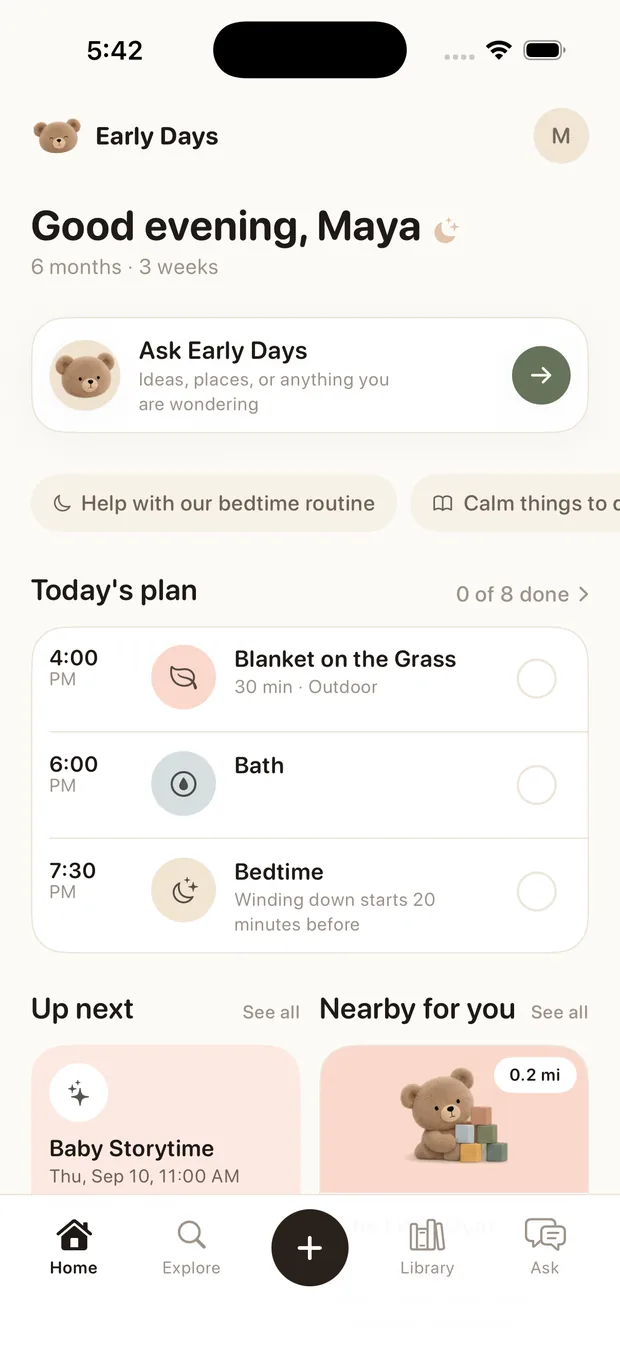

Four fewer things to work out on your own.

How to build a routine that holds
Set the shape of the day once and it is there every morning. Wake, naps, meals and bedtime, built around how old your child is this week, not an average baby.

Somewhere to go, near you
Parks, libraries, museums and indoor play spaces around you, with the real distance from where you are standing.

Everyone on the same page
Parents, nannies and grandparents share one routine and one record, so nobody has to be briefed twice.

Answers you can trust
Twelve long guides on sleep, feeding, play and safety, and every one says at the end where it came from.
This is a Tuesday, handled.
Nothing here is a schedule you have to keep up with. It is the shape of a day that already works, so the decisions are made before you are too tired to make them.
Your routine is already in it
You set it up once. After that the morning is just there, with the next few steps and their times on the home screen.
Somewhere to go, actually near you
Parks, libraries, museums and play spaces, with the real distance from where you are standing. If we cannot confirm the opening hours we say so, instead of guessing.
Nothing suggested during the nap
It knows when the nap is, so it will not put a music class in the middle of it. If the nap gets missed, everything after it gets shorter.
Something to do, when you are out of ideas
One activity, picked for how old your child is right now, dropped into a gap that is actually free. Fifteen minutes, using things you already own.
“We have an hour before dinner and it is raining.”
Water play in the sink, fifteen minutes. Two cups, say full and empty as you pour.
Bedtime the same way, whoever is doing it
Dim light, one book, one song, in that order. When the nanny puts them down on Thursday, she is working from the list you wrote.

Everyone looking after them sees the same plan.
Mom builds the routine. The nanny ticks off the afternoon. Dad sees the whole day from work and knows the bedtime order without being told. Nobody gets briefed twice, and nothing lives in one person’s head.
 You
You Alex
Alex Jenna
JennaTwelve guides, already written.
DevelopmentYour Six Month Old
Half a year in, your baby is starting to work the world with their hands, their middle and their voice. Here is what usually changes, and how wide "usually" really is.
CaregiverLooking After the Caregiver
The rule of three, what actually recovers sleep debt, how to ask for help people can act on, and the mental health section that applies to both parents.
SleepSleep Tips
Winding down in a way that survives an ordinary bad evening, what actually drives sleep, and the safety rules that are not up for negotiation.
Every baby moves at their own pace.
There is not a chart in the whole app. Nothing is scored, nothing is compared, and it will never tell you your child is behind.